
Dear Friends,
Greetings in Christ!
In Acts 11, we saw how the church was starting to thrive in Antioch, where they were first called Christians. In Acts 12, we have more church persecution in Jerusalem, a lesson about prayer, and a warning to those who seek to aggrandize themselves. (Jam 4:10)
Give us understanding, Father, as we read thy word. Fill us with your Holy Spirit, and transform our minds, in Jesus’ name. Amen.
Acts 12
NOW about that time Herod the king stretched forth his hands to vex certain of the church.
Herod the king is Herod Agrippa I, grandson of Herod the not-so-great (Herod I). Herod I had both Mariamne I (Agrippa’s grandmother) and Aristobulus (Agrippa’s father) killed out of paranoia.
Herod I also killed:
• His mother-in-law through his wife Mariamne I, Alexandra.
• Two of his other sons, Alexander and Antipater.
• His brother-in-law through his wife Mariamne I, Aristobulus IV.
• His brother-in-law through his sister, Salome I, Costobarus.
Besides family members, Herod I also killed every baby under two years old around Bethlehem (Matt 2:16), and numerous priests and Jewish leaders. Augustus famously said it was safer to be Herod’s pig than his son. (1)
2 And he killed James the brother of John with the sword.
A chip of the ol’ block, Agrippa has James beheaded. His uncle, Herod Antipas, had John the Baptist beheaded. (Mark 6:27)
James and John desired to be seated at Jesus’ right hand and his left. (Matt 20) Now, James is the first apostle to be martyred for the faith. John will be the last to die. Was this a coincidence or an answer to their petition?
3 And because he saw it pleased the Jews, he proceeded further to take Peter also. (Then were the days of unleavened bread.)
As a client king of Rome, one of Agrippa’s main responsibilities was to prevent discontent and rebellion among the populace in Judea. Peter’s arrest was a political maneuver.
4 And when he had apprehended him, he put him in prison, and delivered him to four quaternions of soldiers to keep him; intending after Easter [Gk pascha] to bring him forth to the people.
Four quaternions of soldiers make sixteen soldiers in total. They probably had four six-hour shifts, with four soldiers on each shift. This is Peter’s third time in prison. Since he mysteriously escaped the last time he was arrested, Agrippa takes extreme measures, thinking he can outsmart Peter and keep him from escaping.
I have heard various explanations for why pascha (lit Passover) is translated as Easter. If Occam’s razor is any guide, it is simply what translators call a ‘dynamic equivalency’. Ie, something that the readers understand more easily than the literal translation, sort of like the word ‘hosen’ in Daniel 3. Of course, Daniel’s friends were not wearing hosen, but whatever they were wearing, it probably would not have made much sense to the Anglo-Saxons reading the KJV in 17th-century England.
As a Jew, Peter was reminded of the Exodus at Passover. As a Christian, Peter was reminded of the death and resurrection of Christ at Passover. Now, Peter will experience his own exodus and his own deliverance from death at Passover.
5 Peter therefore was kept in prison: but prayer was made without ceasing of the church unto God for him.
One of the many things I enjoyed in Zimbabwe was the practice of all-night prayer, where the church would gather and pray until dawn. In the West, we seem to have lost this biblical custom, which is an indictment against us. (I Thess 5:17)
6 And when Herod would have brought him forth, the same night Peter was sleeping between two soldiers, bound with two chains: and the keepers before the door kept the prison.
7 And, behold, the angel of the Lord came upon him, and a light shined in the prison: and he smote Peter on the side, and raised him up, saying, Arise up quickly. And his chains fell off from his hands.
I’m reminded of how Jesus slept through the storm on the sea of Galilee. Peter, awaiting execution, was sleeping so soundly that the angel had to hit him on the side to wake him up. (Ps 4:8; 127:2)
8 And the angel said unto him, Gird thyself, and bind on thy sandals. And so he did. And he saith unto him, Cast thy garment about thee, and follow me.
Peter is naked again. Maybe this was an extra precaution to keep him from escaping, but this seems to be Peter’s preference even when fishing. (John 21:7)
9 And he went out, and followed him; and wist not that it was true which was done by the angel; but thought he saw a vision.
10 When they were past the first and the second ward, they came unto the iron gate that leadeth unto the city; which opened to them of his own accord: and they went out, and passed on through one street; and forthwith the angel departed from him.
The angel easily releases Peter’s chains and opens the iron city gate, probably without even a hand gesture.
11 And when Peter was come to himself, he said, Now I know of a surety, that the Lord hath sent his angel, and hath delivered me out of the hand of Herod, and from all the expectation of the people of the Jews [ie, death].
12 And when he had considered the thing, he came to the house of Mary the mother of John, whose surname was Mark; where many were gathered together praying.
13 And as Peter knocked at the door of the gate, a damsel came to hearken, named Rhoda.
14 And when she knew Peter’s voice, she opened not the gate for gladness, but ran in, and told how Peter stood before the gate.
15 And they said unto her, Thou art mad. But she constantly affirmed that it was even so. Then said they, It is his angel.
J Vernon McGee points out that the word for angel here is not angelos, but pneuma, or literally, spirit. They weren’t saying that it was Peter’s guardian angel, but Peter’s spirit, because they thought he had already been executed.
16 But Peter continued knocking: and when they had opened the door, and saw him, they were astonished.
They were praying for Peter to be released, yet they were astonished when their prayers were answered. I recall praying for a co-worker to get saved when I was working in Carlsbad, CA, in the 90s. Then they sent us both up to the Irvine office to cut pieces of Velcro. As a Scitex Prisma and Mac operator, I felt insulted that I was assigned such a menial task. Then I heard the Holy Spirit say, Haven’t you been praying for him? Now you have your entire shift to witness to him. As a result, he left Mormonism and received Christ as his Saviour.
The takeaway here is, when you pray for something, be ready for the results.
17 But he, beckoning unto them with the hand to hold their peace, declared unto them how the Lord had brought him out of the prison. And he said, Go shew these things unto James, and to the brethren. And he departed, and went into another place.
James, the brother of John, was killed by Agrippa (v 2). Therefore, Peter is referring to James, the Lord’s brother. (Matt 13:55; Gal 1:19) (2) We will not hear much more from Peter in Acts save his appearance in Chapter 15.
In I Corinthians 9:5, Paul mentions that Peter had an itinerant ministry traveling with his wife. We know from his first Epistle that he went to Babylon, and Mark was with him. (I Pet 5:15) Babylon could be a code word for Rome, but Wiersbe makes the interesting observation that if Peter was in fact in Rome, Paul should have mentioned him in his Epistle to the Romans.
18 Now as soon as it was day, there was no small stir among the soldiers, what was become of Peter.
19 And when Herod had sought for him, and found him not, he examined the keepers, and commanded that they should be put to death. [Chip off the ol’ block.] And he [Agrippa] went down from Judæa to Cæsarea, and there abode.
20 And Herod was highly displeased with them of Tyre and Sidon: but they came with one accord to him, and, having made Blastus the king’s chamberlain their friend, desired peace; because their country was nourished by the king’s country.
21 And upon a set day Herod, arrayed in royal apparel, sat upon his throne, and made an oration unto them.
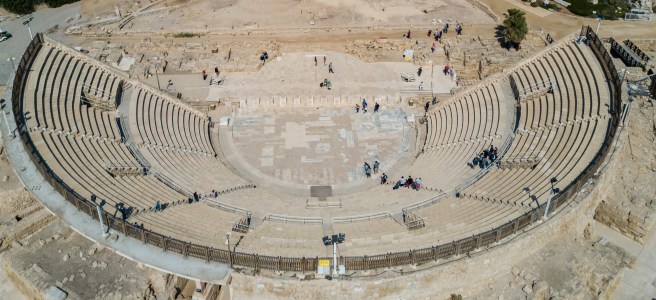
According to Josephus, this took place at the Roman theater in Caesarea, during games in honor of the emperor. Agrippa’s ‘royal apparel’ was made of silver. The sunlight reflecting off the sea and his silver apparel created a theatrical effect. (Like an angel of light, or a shining one?) The theater is still there today.
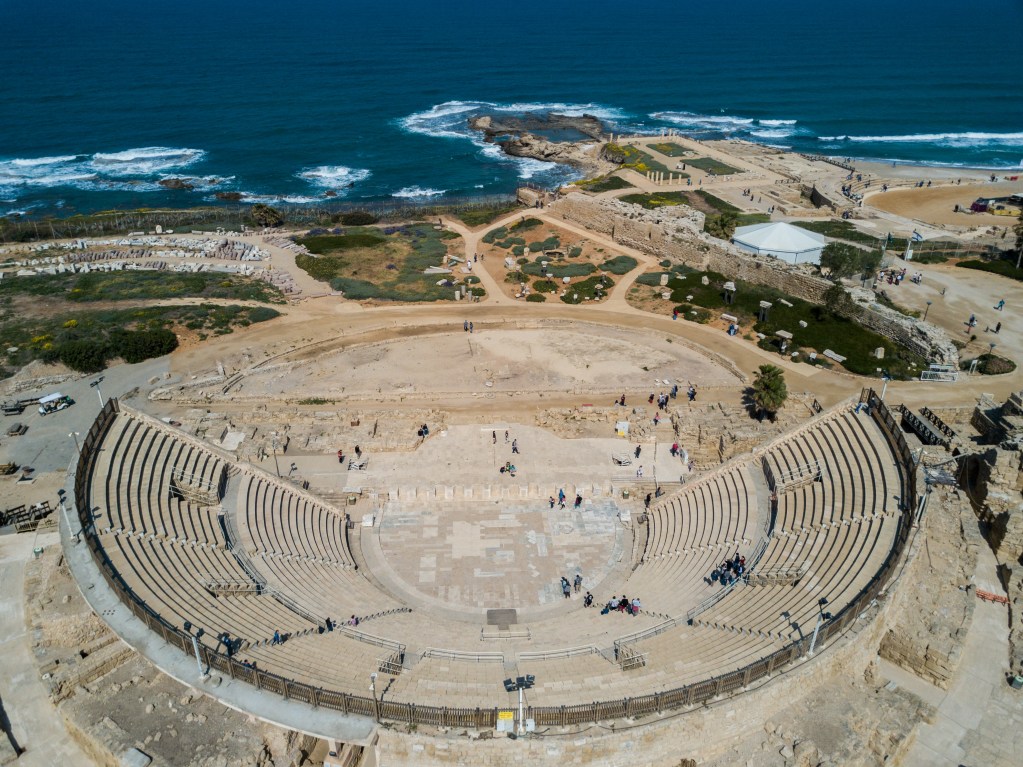 The Theater at Caesarea
22 And the people gave a shout, saying, It is the voice of a god, and not of a man.
23 And immediately the angel of the Lord smote him, because he gave not God the glory: and he was eaten of worms, and gave up the ghost.
24 But the word of God grew and multiplied.
25 And Barnabas and Saul returned from Jerusalem, when they had fulfilled their ministry, and took with them John, whose surname was Mark.
Acts 12
The story of Herod Agrippa I is a reminder of what happens to those who, like Satan, seek or accept the worship which belongs to God alone.
The story of Peter shows how God answers prayer and how God protects his people. (Ps 34:15f; I Pet 3:12) Peter was delivered, while Herod was struck dead. (Pr 11:8)
The story of James shows how persecution grows the church (v 24). The Bible says it is appointed unto men once to die. We all have an appointment. If we should die an untimely death for our faith, we will receive a better resurrection.
As the chapter closes, we see Saul and Barnabas returning to Antioch with John Mark. This foreshadows their first missionary trip, beginning in Chapter 13.
Father, increase our faith, that we may be like those we are reading about in the Book of Acts. Help us to face our challenges with courage as they did. We pray for the word of God to grow and multiply now as it did then, in Jesus’ name. Amen.
1 Macrobius, Saturnaliorum Libri Septem.
2 Or, possibly James, the son of Alphaeus.
